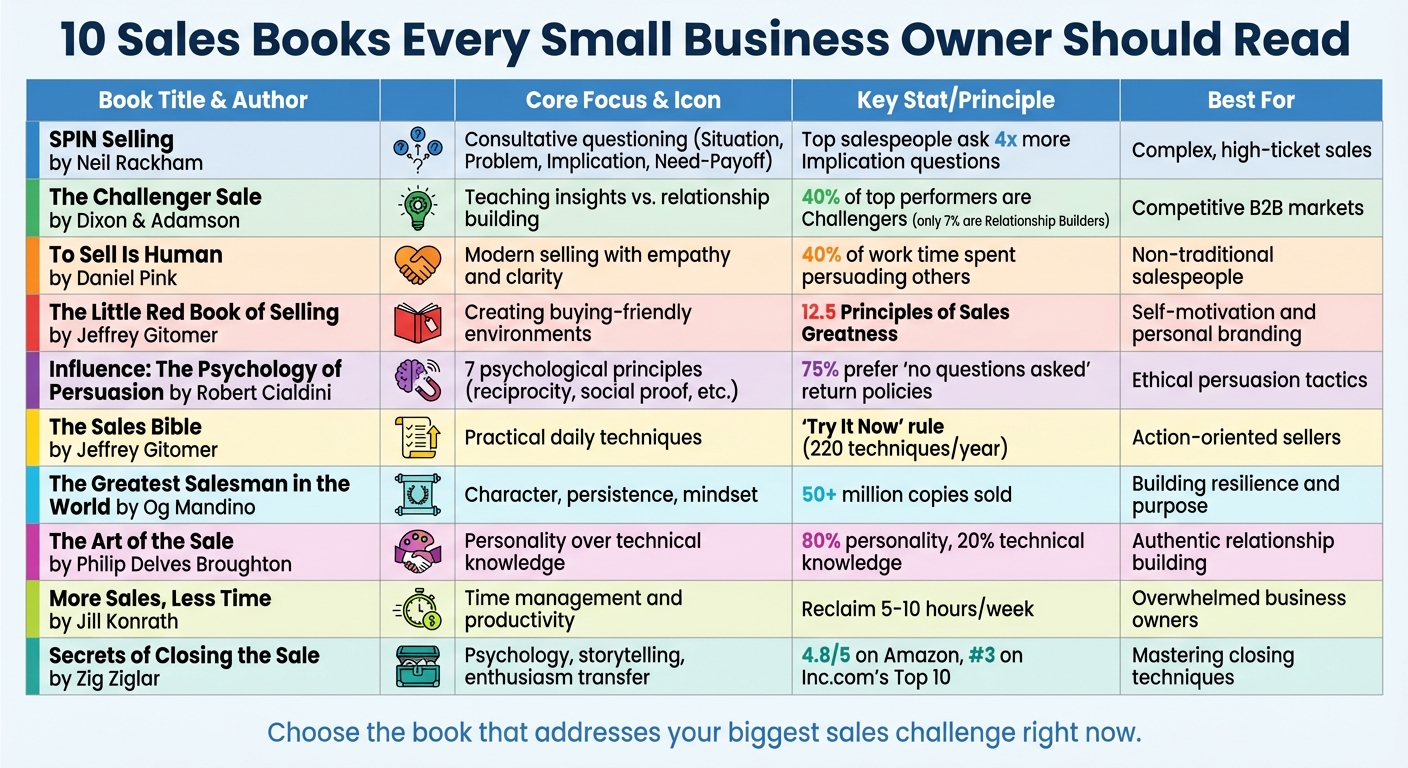
Running a small business means mastering sales, even if it’s not your strong suit. These 10 sales books offer proven strategies to help you close more deals, build stronger customer relationships, and grow your revenue. Whether you're struggling with rejection, time management, or creating a consistent process, these books provide practical solutions tailored for small business owners. Here’s a quick look at what each book covers:
- SPIN Selling: Focuses on consultative questioning to uncover customer needs and prevent objections.
- The Challenger Sale: Teaches how delivering insights can outperform traditional relationship-building.
- To Sell Is Human: Explains how modern selling revolves around empathy, clarity, and connection.
- The Little Red Book of Selling: Emphasizes creating a buying-friendly environment and self-motivation.
- Influence: The Psychology of Persuasion: Breaks down psychological principles like reciprocity and social proof to drive sales.
- The Sales Bible: Offers actionable techniques for closing deals and targeting decision-makers.
- The Greatest Salesman in the World: Focuses on persistence, mindset, and emotional control through timeless lessons.
- The Art of the Sale: Highlights the importance of personality and honest communication in sales.
- More Sales, Less Time: Provides strategies to eliminate distractions and focus on high-impact tasks.
- Zig Ziglar's Secrets of Closing the Sale: Combines storytelling and psychology to help you close with confidence.
These books are packed with actionable advice, making them essential tools for entrepreneurs aiming to improve their sales game. Whether you're new to sales or looking to refine your approach, there’s something here for everyone.
10 Essential Sales Books for Small Business Owners Comparison Guide
The 5 BEST SALES BOOKS You Need to Read Today!
1. SPIN Selling
Neil Rackham's SPIN Selling stems from an impressive 12-year study involving 35,000 sales calls. The research showed that consultative questioning outperforms aggressive closing techniques, especially in complex sales scenarios [9]. For small businesses, this approach can be a game-changer, particularly when dealing with high-ticket items where pushy tactics often backfire [9].
The SPIN framework focuses on four key types of questions:
- Situation: Understand the buyer's current circumstances.
- Problem: Identify challenges or pain points.
- Implication: Explore the consequences of those challenges.
- Need-Payoff: Help the buyer articulate how a solution would benefit them [8].
This structured questioning method transforms minor issues into crucial priorities, making it easier to highlight the value of your solution.
"The best selling isn't at all about your products and what you can offer. It's very much about the customers and their need." – Neil Rackham [10]
Rackham's research found top salespeople ask four times more Implication questions than average performers. This approach can increase close rates by 20% [8]. Instead of relying on scripted responses to objections, the SPIN method focuses on preventing objections altogether by demonstrating value through thoughtful questions [8]. For small businesses, this saves time and ensures a more efficient sales process.
2. The Challenger Sale
Matthew Dixon and Brent Adamson's The Challenger Sale challenges the traditional belief that relationship-building is the cornerstone of successful sales. Their research, which analyzed thousands of sales representatives, found that nearly 40% of top-performing "star" sellers are Challengers, while only 7% fall into the "Relationship Builder" category [12][13]. For small businesses competing with larger companies, this insight is a game-changer. The focus shifts from nurturing relationships to delivering insights, creating a path for stronger revenue growth.
The Challenger approach is built on three key pillars: teaching to stand out, tailoring messages for maximum impact, and confidently managing financial conversations [12][13]. These sellers don't just respond to customer needs - they proactively introduce industry trends and insights to capture interest [13].
Take Xerox, for example. By shifting their sales conversations from printer costs to the benefits of color materials, they achieved a 17% increase in sales and secured $65 million in contract value [13]. Similarly, SAP trained 4,300 salespeople in the Challenger method, leading to a 26% increase in closed deals and 27% more revenue - adding $51 million to their business [13].
"53 percent of B2B customer loyalty is a product of how you sell, not what you sell." – Matthew Dixon and Brent Adamson [14]
For small businesses, adopting the Challenger approach can be transformative. Research shows that 60% of top earners use these techniques [11]. The method emphasizes standing out through insight rather than relying solely on product features - a crucial skill in markets where competing offerings often appear indistinguishable [14]. By applying these strategies, small businesses can enhance their sales performance and complement other methods discussed earlier in this guide.
3. To Sell Is Human
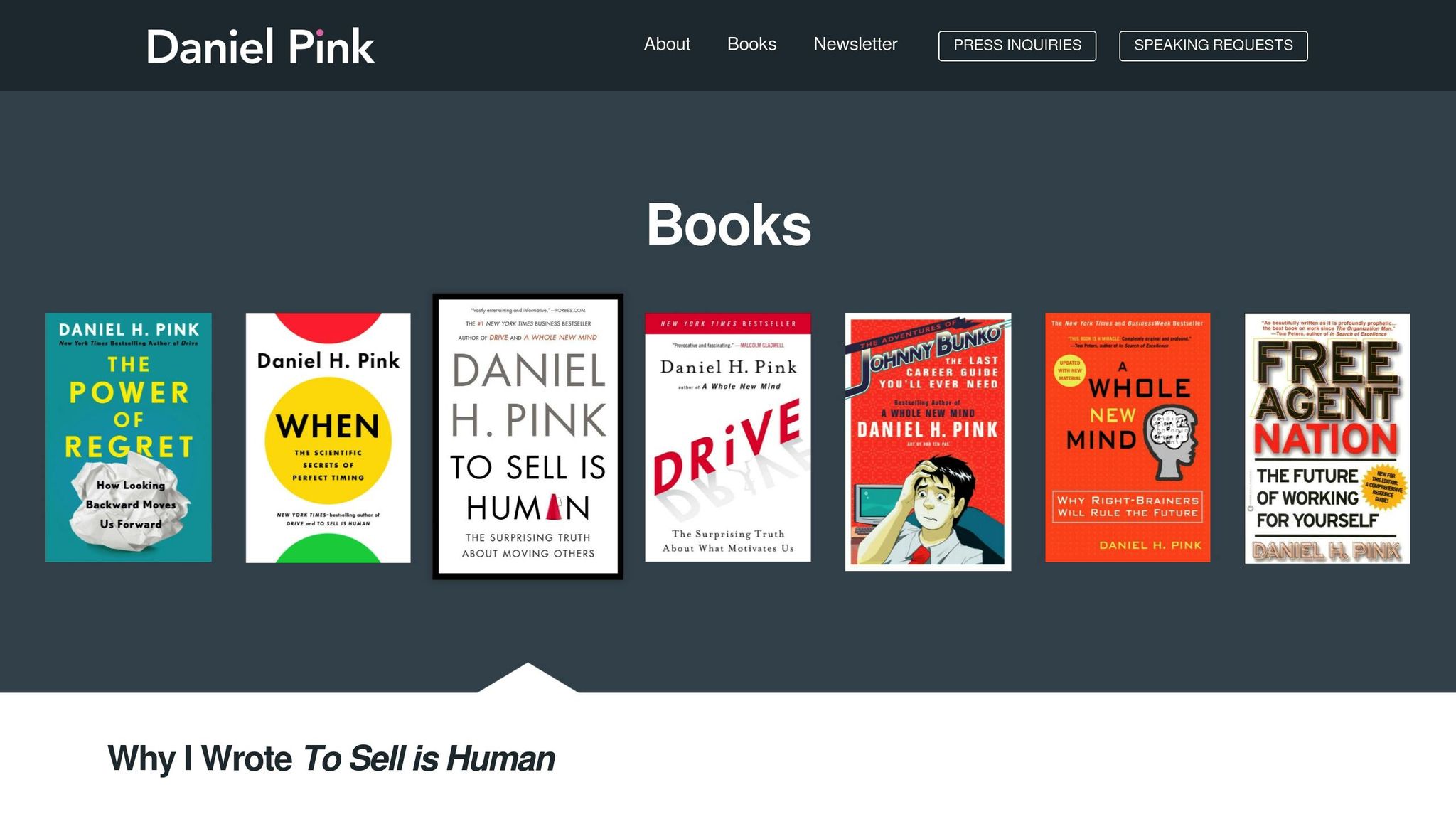
Daniel Pink's book, To Sell Is Human, challenges the traditional ideas about sales with a bold premise: we’re all in sales now. While only one in nine American workers officially holds a sales job, the rest spend roughly 40% of their time persuading, influencing, or convincing others - what Pink refers to as "non-sales selling" [15]. For small business owners who wear many hats, this means you don’t need to adopt the stereotypical "salesperson" persona. Instead, understanding the dynamics of modern selling is what truly makes the difference. Pink’s insights align with earlier strategies, showing that effective sales techniques are more about connection and less about the hard sell.
One of the most compelling ideas in the book is how today's digital age has shifted the balance of power in selling. In the past, sellers held all the information, creating a dynamic of "buyer beware." Now, with information parity, where buyers have just as much access to data as sellers, the tables have turned. Pink reframes this as "seller beware", emphasizing the importance of transparency and delivering genuine value [15].
To navigate this new landscape, Pink introduces the New ABCs of selling, a fresh take on the outdated "Always Be Closing":
- Attunement: Seeing the world through your customer’s eyes.
- Buoyancy: Staying optimistic, even when faced with rejection.
- Clarity: Helping customers uncover problems they didn’t realize they had [15][16].
"To sell well is to convince someone else to part with resources - not to deprive that person, but to leave him better off in the end." – Daniel H. Pink [15]
Another standout concept in the book is the idea of "up-serving" rather than up-selling. Pink encourages leaving customers better off than they were before, focusing on their needs rather than just closing a deal. He also introduces creative pitching techniques, like one-word or question-based pitches, offering practical ways to improve sales effectiveness.
With a 4.9/5 rating from over 21,000 reviews and recognition as a #1 bestseller [16], To Sell Is Human blends social science with actionable advice, redefining what it means to sell in today’s world. It’s a guide that puts the human element at the center of every transaction.
4. The Little Red Book of Selling
Jeffrey Gitomer's The Little Red Book of Selling delivers a simple yet powerful message: "Everyone likes to buy, but no one likes being sold" [17]. For small business owners juggling countless responsibilities, this shift in thinking is a game-changer. Instead of focusing on perfecting a sales pitch, the goal should be to create an environment where customers feel naturally inclined to buy. This customer-first approach is the foundation for Gitomer's practical advice.
The book introduces 12.5 Principles of Sales Greatness, beginning with "Kick Your Own Ass." This principle is a blunt reminder that self-motivation is entirely up to you - no one else can do it for you [17][18]. Gitomer also lays out actionable strategies: research your prospects thoroughly before meetings, establish a personal brand that highlights who you are, and make a point to connect directly with decision-makers [17][18].
Gitomer highlights the power of asking "power questions" - thought-provoking questions designed to shift a prospect's perspective. For instance, open with lines like, "What has been your experience with...?" or "What is your biggest hurdle to...?" These types of questions uncover deeper insights into the customer's needs [17]. Humor also plays a key role in his approach, helping to ease tension and build rapport. Additionally, Gitomer advises addressing specific customer concerns to eliminate risk and leveraging testimonials. As he puts it, "When you say it about yourself, it's bragging. When someone else says it about you, it's proof" [18].
The book stresses the importance of focusing on personal and business growth rather than getting caught up in unproductive distractions [17][18]. This relationship-driven strategy prioritizes building trust and long-term connections over aggressive sales tactics, making it particularly relevant for small business owners working in close-knit communities.
Gitomer's belief that "Questions are to sales as breath is to life; neglect them at your own risk" [1] encapsulates his straightforward philosophy. It's not about pushing products; it's about delivering enough value that price becomes a secondary concern [17].
5. Influence: The Psychology of Persuasion
Robert Cialdini's Influence: The Psychology of Persuasion has earned its reputation as a cornerstone of marketing and sales psychology [6][3]. The book lays out seven key principles that explain what drives people to say "yes" and provides actionable advice for small business owners. These strategies are not only effective but also straightforward to implement, making them perfect for businesses working with limited resources [20]. They serve as a foundation for ethical and impactful persuasion in sales.
One of the standout principles is reciprocity. When you give something first - like a free sample, valuable content, or an unexpected gift - people often feel an urge to give back. For instance, Anima Mundi Apothecary provides free samples with a minimum order, and Warby Parker’s Home Try-On program allows customers to try five frames at no cost. Both approaches tap into reciprocity to encourage customer loyalty [19].
Another principle, social proof, is equally compelling. It complements reciprocity by fostering trust and reliability. For example, nearly 75% of consumers prefer businesses with a "no questions asked" return policy, while companies with ratings below four stars often struggle to gain customer confidence [19]. Brands like Partake Foods leverage this by showcasing customer reviews prominently on their website, while HELM Boots partners with influencers like Liz Lambert to enhance their appeal through trusted endorsements [19].
Cialdini also highlights the power of loss aversion - the idea that people are more motivated to avoid losses than to achieve equivalent gains [7]. Tactics such as "only X items left" notifications or "limited edition" labels are easy to adopt and can create a sense of urgency without requiring a hefty marketing budget.
Chris Voss, author of Never Split the Difference, emphasizes the book’s value:
"Anyone who wants their abilities in communication or negotiation to be at their highest level has to read Robert Cialdini's book Influence. Your knowledge base is simply incomplete without it" [20].
Available as an e-book for $12.99 [20], Influence delivers practical strategies you can start using right away.
6. The Sales Bible
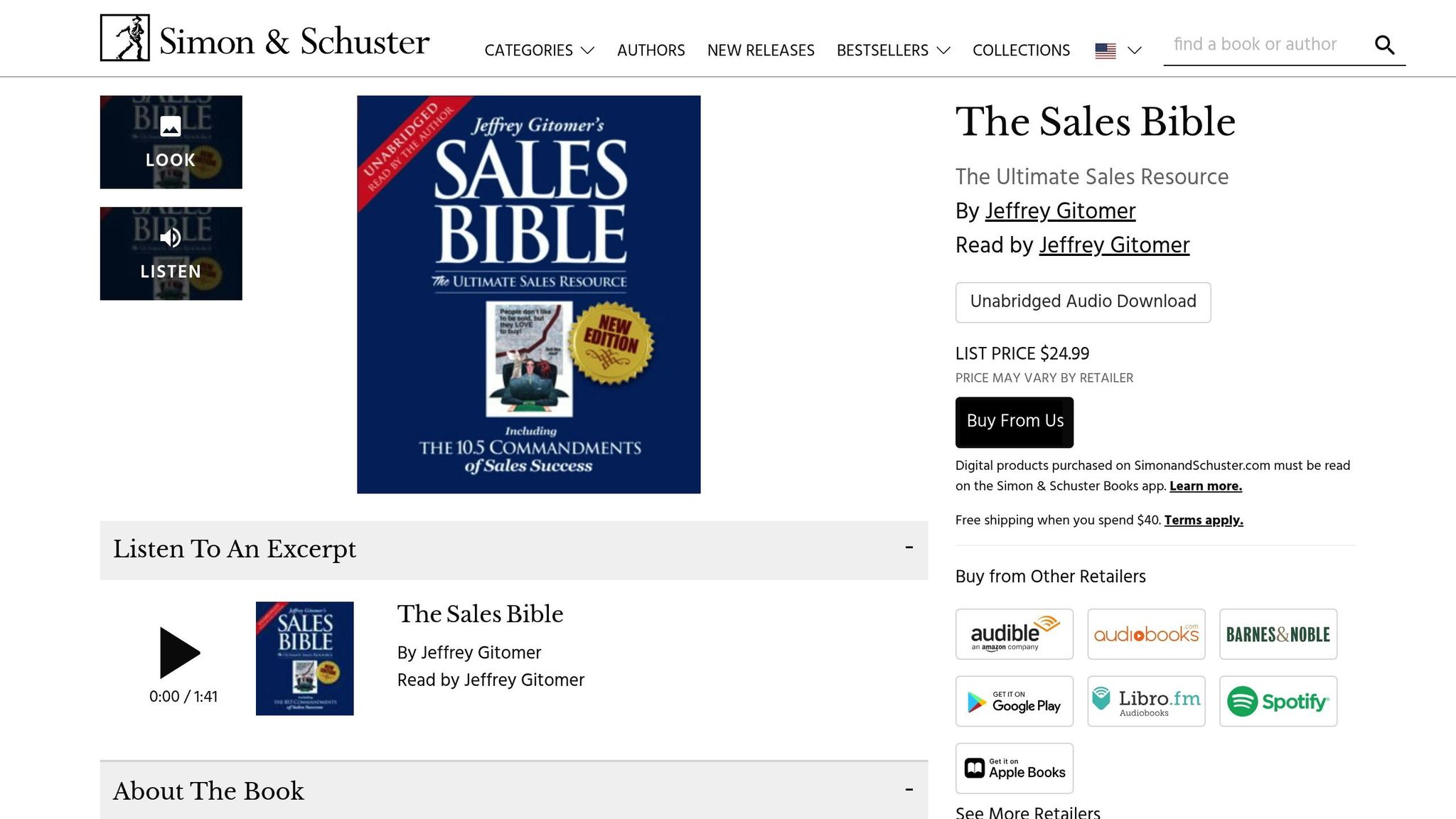
Jeffrey Gitomer's The Sales Bible serves as a practical guide packed with hands-on techniques that you can adapt to fit your unique selling style. With over 200,000 copies sold across its previous editions [21], the book has cemented its reputation as one of Inc.com's "Top 10 'How to Sell' Books of All Time" [5]. Gitomer, whose weekly column "Sales Moves" reaches an audience of more than 4 million readers worldwide [21], brings his wealth of experience directly to the pages of this book.
The content focuses on real-world challenges small business owners face daily, from mastering cold calls to sealing deals. One standout strategy is top-down selling, which emphasizes targeting high-level decision-makers within organizations. This approach helps fill your sales pipeline with prospects who are ready to make decisions quickly [21]. It aligns perfectly with Gitomer's action-oriented philosophy.
One of the book's most actionable tips is Gitomer's "Try It Now" rule: apply one new technique each day to a real customer or prospect. Over the course of a standard 220-workday year, that’s more than 200 new strategies you can test and refine [21]. This method transforms the act of reading into a series of practical steps, making it an ideal resource for small business owners who need immediate results.
"People don't like to be sold, but they LOVE to buy." - Jeffrey Gitomer [21]
Priced at $23.00 [21], The Sales Bible includes flashcards for quick reference during sales calls and provides 25 proven methods for securing appointments with even the most elusive prospects [21]. Whether you’re skimming a chapter during lunch or diving into specific sections to prep for a big pitch, this book is a reliable tool to keep your motivation high and your sales skills sharp [21].
sbb-itb-1ae7b2a
7. The Greatest Salesman in the World
Og Mandino's The Greatest Salesman in the World stands apart from typical sales guides. Since its release in 1968, it has sold over 50 million copies globally [23]. Instead of technical advice, the book delivers its lessons through a fable, focusing on timeless ideas like character, persistence, and the deeper purpose of selling. Mandino redefines sales as a way to serve others and help them reach their goals [2]. This outlook complements the more tactical approaches often discussed, giving small business owners a well-rounded perspective on sales.
The structure of the book is as unique as its message. It features ten scrolls, each containing a core principle. Readers are encouraged to read each scroll three times daily for 30 days before moving on to the next, making this a nearly 10-month journey [22]. This repetition is deliberate - it’s meant to turn these principles into lasting habits. For example, Scroll IX focuses on the mantra "I will act now", repeating the phrase 18 times to emphasize the importance of taking immediate action rather than overthinking [22][23].
For small business owners, who often face rejection and setbacks, Scroll III offers a fresh perspective:
"Obstacles are necessary for success because in selling, as in all careers of importance, victory comes only after many struggles and countless defeats" [22].
This mindset reframes rejection as progress toward success rather than a personal failure. Similarly, Scroll VI focuses on emotional control, reminding readers not to let a lost deal in the morning ruin their approach for the rest of the day [22].
"Work is not your enemy but your friend. If all manners of labor were forbidden to thee you would fall to your knees and beg an early death." - Og Mandino [22]
Scroll VIII encourages continuously increasing the value you offer and going above and beyond for customers. This isn’t about working more hours - it’s about finding smarter ways to solve problems and deliver greater value. Paired with the "act now" philosophy, these lessons not only improve sales skills but also build resilience and character.
8. The Art of the Sale

Philip Delves Broughton's The Art of the Sale takes a refreshing perspective on what truly drives sales success. According to the book, it’s not just about knowing your product inside and out - it’s about connecting with people. In fact, Broughton argues that success in sales is 80% personality and 20% technical knowledge[1]. This principle emphasizes the importance of authenticity and empathy over simply pushing product details.
The book doesn’t stop at theory. It offers over 50 practical techniques designed to help salespeople lead themselves effectively, which in turn helps guide customers through their decision-making process. By focusing on self-leadership, you naturally build stronger trust with your customers.
At its core, The Art of the Sale highlights the power of honest communication. Clearly defining what you’re offering not only fosters trust but also lays the foundation for lasting customer relationships. For small businesses, this approach can lead to both stronger connections and steady revenue growth over time.
9. More Sales, Less Time
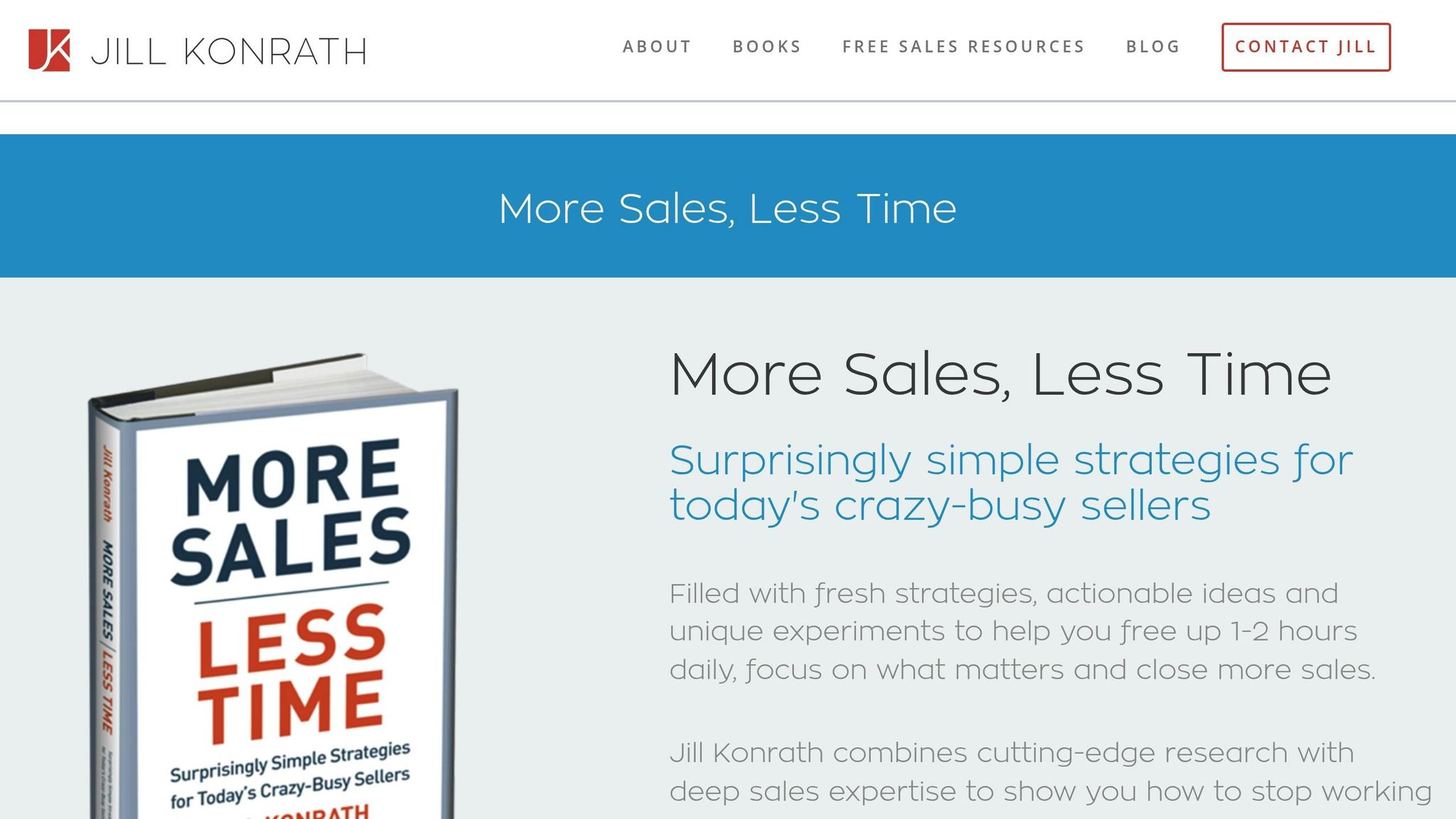
When it comes to boosting sales, managing your time effectively is just as important as using the right tactics. Jill Konrath's book, More Sales, Less Time, dives into how cutting out unproductive tasks can lead to better results. The main takeaway? Sell more by doing less. As Brent Adamson, Principal Executive Advisor at CEB, puts it:
"Jill Konrath understands it's not about selling more by doing more - it's about selling more by doing less" [24].
Konrath zeroes in on common time-wasters like email and social media, which often interrupt focus and drain productivity. Her strategies aim to help you reclaim 1 to 2 hours of productive time every day, adding up to 5–10 hours a week that can be redirected toward closing deals [24][26].
The book offers practical advice, such as grouping similar tasks together (known as batching) and experimenting with time-saving methods to find what works best for you. The key is making tough choices - focusing on high-impact tasks while cutting out distractions. Daniel H. Pink, author of To Sell Is Human, highlights the book’s value:
"research-tested strategies for time management tailored to the special needs of sales work" [24].
For small business owners managing sales teams, Konrath suggests creating team challenges to motivate everyone to reclaim lost time and improve revenue per salesperson [25]. Her philosophy, "slow down to speed up", encourages taking a step back to assess your activities and focus on what truly drives results [24].
10. Zig Ziglar's Secrets of Closing the Sale
Zig Ziglar's sales techniques are a fascinating mix of psychology, humor, and storytelling that set them apart from more data-heavy approaches [5] [31]. Ranked #3 on Inc.com's "Top 10 How to Sell Books of All Time", Ziglar has earned a reputation as one of the most influential voices in sales [5].
At the heart of Ziglar's philosophy is the idea that sales is essentially a transfer of enthusiasm from seller to buyer. He stresses that to close a sale effectively, you must genuinely believe that your product or service will improve your customer's life. This aligns with the broader notion that authentic relationships are the foundation of lasting business success. Mary Kay Ash, the founder of Mary Kay Cosmetics, famously referred to Ziglar as the "number one salesman of our time" [30]. His well-known mantra perfectly encapsulates his customer-centric approach:
"You can get everything you want in life if you just help other people get what they want." [31]
In his book, Ziglar translates this philosophy into actionable strategies. Some of his standout techniques include the Tie-Down method, where you answer a prospect's question with a clarifying question to guide the conversation; the Cost Close, which shifts focus from upfront costs to long-term value; and the CHEF Method, a clever way to read body language cues - like chin rubbing, hand movements, wide eyes, or smiling - to determine the perfect moment to close the deal.
Though some may find parts of his advice less aligned with today's digital-first sales landscape, Ziglar's methods remain a treasure trove of emotional and strategic insights. With a 4.8/5 rating on Amazon [27], the book continues to be a favorite among sales professionals. Priced at $20.00 for the paperback [28] [29], it offers practical lessons that complement modern sales strategies, making it a valuable resource for small business owners looking to refine their closing techniques.
How These Books Help Increase Small Business Revenue
Small business owners often excel at their craft but face challenges when it comes to stepping back from daily operations to focus on broader strategies for growth. These books provide practical frameworks that help create efficient systems and processes, ensuring the business can thrive even without the owner’s constant involvement [3][32]. By implementing these strategies, owners can streamline their sales processes and devote more energy to driving long-term growth.
The modern buyer is increasingly wary of outdated, pushy sales tactics. Books like To Sell Is Human and SPIN Selling advocate for a consultative approach to sales - one that prioritizes solving customer problems over simply pushing products [7]. Neil Rackham, the author of SPIN Selling, captures this shift perfectly:
"People do not buy from salespeople because they understand their products but because they felt the salesperson understood their problems" [7].
This shift in perspective can redefine how small businesses interact with customers, leading to stronger connections and more successful deals.
These books also help business owners sidestep common pitfalls by learning from the experiences of seasoned sales professionals. Instead of relying solely on trial and error, readers can gain actionable insights from real-world challenges others have faced. For example, Bruce Eckfeldt, founder of Eckfeldt Technology, once struggled with leads going silent. By adopting Neil Rackham's SPIN framework, he replaced reliance on rapport and luck with a structured system for qualifying leads, resulting in more consistent outcomes [4].
In addition to consultative techniques, these guides emphasize the power of data and technology in building scalable sales strategies. Experts like Mark Roberge demonstrate how leveraging data can create productive, repeatable systems, moving away from gut-based decision-making [7]. Similarly, Scott Shrum, President and COO of Hennessey Digital, applied the "clock builder" concept from Jim Collins's Built to Last to transition from being the sole decision-maker to empowering teams to generate ideas and solve problems independently [6]. This shift allowed him to focus on long-term strategy instead of being bogged down in daily operations.
Ultimately, these techniques establish an environment where customers feel naturally inclined to buy [1][2]. Together, these books offer a clear roadmap for creating systems that not only boost revenue but also build a sustainable, customer-focused business.
Conclusion
Throughout this guide, we've delved into strategies that reshape how small business owners approach sales. The ten sales books highlighted here serve as a practical guide to boosting revenue. They provide insights from seasoned professionals, offering lessons learned from their successes and failures. As Salesforce aptly put it:
"Every page you turn is a shortcut to success" [3].
These books challenge the old view of selling as a manipulative act, reframing it as a way to genuinely solve customer problems. Gitomer's advice about creating an environment where customers are eager to buy underscores this shift in mindset.
Beyond perspective, these resources equip you with actionable techniques that drive results. Whether it's leveraging the SPIN questioning method, adopting the Challenger approach, or streamlining processes to reduce your hands-on involvement, these tools are designed to make a tangible impact on your bottom line. You'll find strategies to strengthen customer relationships, optimize your time during key prospecting moments, and manage your sales efforts more effectively.
With over 340,737 sales-related titles available on Amazon [5], these ten stand out for their relevance and practicality, especially for small business owners looking for immediate results. Start by picking the book that addresses your biggest challenge right now, and apply its strategies to gain a competitive edge in today’s tough marketplace.
FAQs
How can these sales books help small business owners improve their sales strategies?
Sales books offer small business owners a treasure trove of strategies to refine their sales approach and boost revenue. Take The Challenger Sale, for example - it shifts the focus from standard sales pitches to conversations packed with insights, making it easier to earn trust and close deals. On the other hand, To Sell Is Human highlights the importance of prioritizing customers' needs, teaching owners how to position their products as solutions rather than resorting to pushy tactics.
Books like Fanatical Prospecting and The Science of Selling dive into critical skills such as prospecting and persuasion, providing clear, actionable steps to attract and engage more qualified leads. But these books don’t stop at techniques - they also guide owners on aligning their sales strategies with broader business goals. This means saving time, avoiding burnout, and building scalable systems that support sustainable growth. By embracing these methods, small business owners can not only improve their conversion rates but also foster deeper, more meaningful customer relationships.
What is SPIN Selling, and how is it different from traditional sales methods?
SPIN Selling, introduced by Neil Rackham, is a structured sales technique that revolves around asking four key types of questions during a conversation: Situation (to gather details about the buyer's current circumstances), Problem (to pinpoint the challenges they’re facing), Implication (to dig into the consequences of those challenges), and Need-Payoff (to show how your solution can address their specific needs). This approach is grounded in research from over 35,000 sales calls and works particularly well for complex, high-stakes deals.
What sets SPIN Selling apart from traditional sales methods is its focus on understanding the buyer before presenting solutions. Instead of jumping straight into pitching product features and benefits, this method encourages a consultative approach. By asking open-ended questions, salespeople create a dialogue aimed at solving problems rather than just making a sale. It’s an especially powerful tool for small business owners who want to build trust and close larger, more intricate deals by offering solutions tailored to their buyer’s unique challenges.
What are the benefits of the Challenger Sale approach for small business owners?
The Challenger Sale approach moves away from the traditional focus on relationship-building and instead emphasizes delivering new insights that address a prospect's specific challenges. By teaching fresh perspectives, customizing messages to align with individual needs, and navigating the decision-making process, small businesses can position themselves as trusted experts. This strategy not only accelerates the sales cycle but also reduces the reliance on time-consuming relationship-building - making it a great fit for businesses with limited resources.
For small businesses operating in competitive markets, the Challenger model proves especially effective for securing complex deals. It enables business owners to present strong, clear business cases, engage with multiple decision-makers, and keep the sales process moving forward. Unlike traditional sales methods that often depend on familiarity and rapport, this approach focuses on standing out through differentiation and delivering measurable value - helping smaller businesses compete effectively against larger players.